- English
- French
- German
- Portuguese
- Spanish
- Russian
- Japanese
- Korean
- Arabic
- Greek
- German
- Turkish
- Italian
- Danish
- Romanian
- Indonesian
- Czech
- Afrikaans
- Swedish
- Polish
- Basque
- Catalan
- Esperanto
- Hindi
- Lao
- Albanian
- Amharic
- Armenian
- Azerbaijani
- Belarusian
- Bengali
- Bosnian
- Bulgarian
- Cebuano
- Chichewa
- Corsican
- Croatian
- Dutch
- Estonian
- Filipino
- Finnish
- Frisian
- Galician
- Georgian
- Gujarati
- Haitian
- Hausa
- Hawaiian
- Hebrew
- Hmong
- Hungarian
- Icelandic
- Igbo
- Javanese
- Kannada
- Kazakh
- Khmer
- Kurdish
- Kyrgyz
- Latin
- Latvian
- Lithuanian
- Luxembou..
- Macedonian
- Malagasy
- Malay
- Malayalam
- Maltese
- Maori
- Marathi
- Mongolian
- Burmese
- Nepali
- Norwegian
- Pashto
- Persian
- Punjabi
- Serbian
- Sesotho
- Sinhala
- Slovak
- Slovenian
- Somali
- Samoan
- Scots Gaelic
- Shona
- Sindhi
- Sundanese
- Swahili
- Tajik
- Tamil
- Telugu
- Thai
- Ukrainian
- Urdu
- Uzbek
- Vietnamese
- Welsh
- Xhosa
- Yiddish
- Yoruba
- Zulu
How Does Nattokinase Powder Work in the Body?
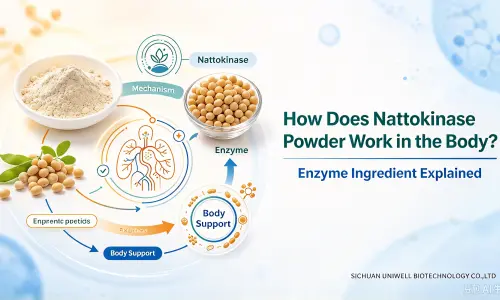
Nattokinase powder is a serine protease enzyme derived from Bacillus subtilis natto fermentation of soybeans. Once ingested orally, it survives gastric transit and enters systemic circulation, where it directly degrades cross-linked fibrin clots through proteolytic activity. It also stimulates the body's endogenous tissue plasminogen activator (t-PA), reinforcing natural fibrinolysis. Research published in Scientific Reports (2015) confirmed oral bioavailability in human subjects. For procurement professionals evaluating cardiovascular ingredient portfolios, nattokinase powder standardized at 20,000 FU/g represents a measurable, mechanism-backed active with documented in vivo action.
Understanding Nattokinase Powder and Its Role in the Body
What Nattokinase Powder Actually Is?
Nattokinase powder is a pure fibrinolytic enzyme that comes from natto, a Japanese food made from fermented soy beans that has been eaten for hundreds of years. This is a serine protease from the subtilisin family. It has a molecular weight of about 27.7 kDa and is made up of 275 amino acid residues. Unlike most proteases, it specifically targets cross-linked fibrin, which makes it more useful as an ingredient in cardiovascular products than as a digestive enzyme that works on a wide range of proteins.
The Fibrin Degradation Mechanism
Fibrin is the protein that makes blood clots stay together. Nattokinase powder increases the production of t-PA in the body while directly cleaving fibrin strands. This mechanism does two things: it lowers the number of clots that are already there and helps the body's own anticoagulation response. A study published in 2006 in the journal Acta Haematologica showed that giving healthy volunteers nattokinase by mouth lowered their levels of fibrinogen and clotting factor within hours of doing so.
Why FU/g Standardization Matters for Procurement?
Fibrinolytic Units per gram (FU/g) is the standard way to measure how well nattokinase works. It was confirmed by the Fibrin Plate Method, which follows the rules set by the Japan Natto Association. Nattokinase powder that is defined at 20,000 FU/g gives formulators an exact, repeatable activity level that they can use to make sure that products are always dosed correctly. Without FU/g data that has been checked by a third party, variation from batch to batch can make product claims less reliable and hurt the credibility of a brand in regulated markets.
How Nattokinase Powder Works to Support Heart Health?
Blood Circulation and Thrombosis Prevention
The most well-known benefit of nattokinase powder is that it can lower the chance of thrombosis by breaking up fibrin clumps in blood vessels. Better circulation makes the walls of arteries less stressed and stops platelets from sticking together. In 2008, Hypertension Research released the results of a randomized controlled trial that showed taking nattokinase supplements for 12 weeks lowered both systolic and diastolic blood pressure. This made it a natural option for heart health products.
Blood Pressure Modulation
Besides breaking down fibrin, nattokinase also stops the activity of angiotensin-converting enzyme (ACE), which is the same way that drugs that lower blood pressure do it. This secondary action helps the blood vessels open up and the arteries bend. The fact that a single ingredient can break down fibrin and mildly block ACE makes it a very useful ingredient for formulators making products for people aged 50 and up, especially when mixed with CoQ10 or magnesium in a cardiovascular blend.
Cognitive Health via Cerebral Blood Flow
For sustained cognitive function, the blood flow to the brain must be at its best. Nattokinase powder helps get oxygen and nutrients to brain tissue by keeping the blood fluid and preventing microvascular clots from forming. This means that fermented nattokinase extract can be used as an ingredient in combination SKUs that support both heart health and brain health. This is a growing market area in both the Japanese “Foods with Function Claims” category and the U.S. DSHEA structure-function supplement market.
Optimal Usage and Dosage Guidelines for Nattokinase Powder
Clinically Referenced Dosage Ranges
Most studies on humans that have been published have used daily amounts of between 2,000 and 4,000 FU, which are usually given in the form of capsules or tablets. This equals 100–200 mg per dose at 20,000 FU/g standardization, which is a good amount for normal two-piece hard-shell capsules. It is important for procurement teams to make sure that the FU/g values used by suppliers are the Japan Natto Association Fibrin Plate Method and not chromogenic substrate assays, which measure overall protease activity instead of specific fibrinolytic function.
Timing, Stability, and Delivery Format Considerations
Above 55–60°C, nattokinase starts to change shape, so it can't be used in hot drinks. It works best in enteric-coated capsules or regular gelatin capsules that are taken between meals, when the stomach's pH is not as acidic. When used in powder blends, maltodextrin or microcrystalline cellulose carriers lower the ability of enzymes to absorb water and keep their structure. When buying raw materials for tableting or packaging, procurement workers should ask for flowability and bulk density data along with the activity certificate.
Regulatory and Safety Protocols
Nattokinase powder is generally thought to be safe when used in dietary supplement forms. However, it shouldn't be given at the same time as prescription blood thinners like warfarin without a doctor's supervision, since the two drugs may slow the blood clotting process even more. For markets that need to file for in Japan or notify the KFDA in Korea, sellers must provide full safety dossiers, third-party COA data, and documents for strain authentication. These needs are met by UNIWELL's fermented nattokinase extract, and proof is available upon request.
Comparing Nattokinase Powder to Other Market Solutions
Powder vs. Encapsulated Grades
Compared to pre-encapsulated grades, bulk nattokinase powder gives you more options for how to make the product and costs less per unit as a raw material. It fits easily into custom capsule lines, powder sachets, and premixes for nutraceuticals. The downside is that the enzyme is sensitive to handling—it needs to be processed in dry places and kept in sealed containers. UNIWELL sells nattokinase powder in 25 kg drums with two food-grade plastic covers. This keeps the activity level stable while the powder is being stored and shipped.
Taiwan-Origin vs. Japan-Origin: A Procurement Perspective
Fermented nattokinase from Taiwan has become a reliable, cost-effective alternative to material from Japan, without lowering the quality. Taiwanese facilities use fermentation skills they've honed over many years, using the real Bacillus subtilis natto strain and strict food-grade controls. The same Fibrin Plate Method is used for activity testing, which is approved by the Japan Natto Association. For procurement workers who have to keep an eye on costs in a supplement market that is very competitive, Taiwan-origin material with a proven 20,000 FU/g activity level is a great deal that doesn't skimp on quality.
Quality Certification Benchmarks
Here are the approval and safety standards that buying teams should demand from any company that sells nattokinase powder:
- Activity verification: Fibrin Plate Method, third-party tested, 20,000 FU/g minimum confirmed per lot
- Heavy metals: Pb ≤ 2.0 mg/kg, As ≤ 1.0 mg/kg, Cd ≤ 1.0 mg/kg, Hg ≤ 0.1 mg/kg
- Microbiology: TAMC ≤ 10,000 CFU/g; E. coli, Salmonella, and Staphylococcus aureus absent
- Mycotoxins: Aflatoxins and ochratoxin A tested to EU food safety limits
- Certifications: FDA, ISO 22000, HALAL, KOSHER
Brands that want to sell their products in Japan, Korea, the EU, or the US must follow these rules. There is too much risk in the supply chain when a seller can't provide full lot-level paperwork against each benchmark.
Not being able to meet any of these requirements is not a differentiator for qualified nattokinase raw material procurement.
Business Applications: Procuring Nattokinase Powder for B2B Use
Supplier Validation and Cost Strategy
It's not enough to just compare prices when looking for a nattokinase powder provider. Activity claims need to be checked by a third party, and strain authentication should use well-known standards. A supplier's lead times, minimum order amounts, and product depth show if they can help you move from a trial to a yearly contract. UNIWELL keeps more than 100 metric tons of strategic raw materials in stock, which means that standard orders can be shipped within three business days. This is a big help for procurement teams that are trying to meet tight launch deadlines.
OEM and Custom Formulation Support
UNIWELL offers full ODM/OEM services for brands that need unique activity grades, private labels, or help with formulation integration. Our expert team helps with choosing the right carrier, making sure the packaging works with the target market, and writing the necessary paperwork for USP/NF, EU Novel Food, and Japanese frameworks. A full COA is sent with every batch. It has an activity certificate, a heavy metal report, and microbiological testing data.
Long-Term Supply Partnership
As important as quality at the start is a steady source of goods. UNIWELL has direct agreements with certified Taiwanese fermentation facilities and has been exporting to the EU, the U.S., and Southeast Asian markets for ten years. This gives buying teams a stable supply chain that can be checked. Trial orders and long-term annual contracts can both be accommodated by flexible packaging options, such as lots of less than 25 kg and custom labeling.
Conclusion
Direct fibrin breakdown and increase of endogenous t-PA are two well-known mechanisms by which nattokinase powder functions. These two mechanisms support healthy blood flow and heart function. The quality of the nattokinase raw material, specifically its FU/g activity, strain authenticity, and third-party compliance documentation, tells B2B procurement professionals if the finished product does what it's supposed to do. With 20,000 FU/g and testing that is in line with the Japan Natto Association, UNIWELL's fermented nattokinase from Taiwan has the activity and paperwork quality that controlled markets need.
FAQ
1. Is nattokinase powder safe for long-term use?
Human studies spanning up to 26 weeks have reported no serious adverse events at doses of 2,000–4,000 FU daily. Long-term safety data beyond one year remains limited in published clinical literature. Procurement teams should note that existing human trial data supports short-to-medium-term use within standard supplement dosing ranges.
2. Can nattokinase be taken with blood thinners?
Nattokinase powder has additive fibrinolytic effects that may interact with anticoagulant medications, including warfarin and direct oral anticoagulants. Product labels in regulated markets should carry appropriate advisory language. Brands targeting the 50+ cardiovascular segment should include interaction disclosures aligned with FDA DSHEA structure-function claim guidelines.
3. How do I verify the actual potency of a nattokinase ingredient?
Request third-party activity testing using the Fibrin Plate Method consistent with Japan Natto Association protocols. Be cautious of chromogenic substrate assay results, as they measure total protease activity rather than fibrin-specific lytic function, which can overstate actual nattokinase potency.
4. What is Vitamin K2 removal, and why does it matter?
Natto naturally contains Vitamin K2 (MK-7), which can interfere with warfarin therapy. For supplement-grade nattokinase powder, chromatographic purification or oil extraction removes K2 to below 0.1 ppm. Always request a K2 content report alongside the activity certificate when evaluating supplier materials.
Partner with UNIWELL for Certified Nattokinase Powder Supply
The 20,000 FU/g nattokinase powder that UNIWELL sells comes from real fermentation in Taiwan and is backed by ISO 22000, FDA, HALAL, and KOSHER certificates. All of the lots come with a full COA, an activity certificate, and compliance reports from a third party. UNIWELL is the nattokinase powder provider that buying teams go back to because they have a large inventory that allows for same-week shipping and can customize products through ODM to meet global regulatory needs. To get samples and prices, email us at info@uniwellbio.com.
References
1. Sumi, H., Hamada, H., Tsushima, H., Mihara, H., & Muraki, H. — Experientia, 1987
2. Hsia, C. H., Shen, M. C., Lin, J. S., Wen, Y. K., Hwang, K. L., Cham, T. M., & Yang, N. C. — Hypertension Research, 2009
3. Fujita, M., Nomura, K., Hong, K., Ito, Y., Asada, A., & Nishimuro, S. — Biochemical and Biophysical Research Communications, 1993
4. Urano, T., Ihara, H., Umemura, K., Suzuki, Y., Oike, M., Akita, S., Tsukamoto, Y., Suzuki, I., & Takada, A. — Journal of Agricultural and Food Chemistry, 2001
5. Kim, J. Y., Gum, S. N., Paik, J. K., Lim, H. H., Kim, K. C., Ogasawara, K., Inoue, K., Park, S., Jang, Y., & Lee, J. H. — Nutrition Research and Practice, 2008
6. Jensen, G. S., Lenninger, M., Ero, M. P., & Benson, K. F. — Integrative Medicine: A Clinician's Journal, 2016
Have a project in mind? Share your requirements — we’ll turn your ideas into reliable products.